You know the saying: You can’t judge a book by its cover. With
magazines, it’s pretty much the opposite. The cover of a magazine is the
unified identity for a whole host of ideas, authors, and designers who
have created the eclectic array of stories and articles and materials
within each issue. And, some would argue, this identity extends to the
reader as well. If you’re seen with an issue of Vogue, you don’t just own that copy—you become a Vogue reader.
Magazine covers are a challenge to design, since they have to be both
ever-changing and also consistently recognizable. For this reason, most
publications stick to a standard set of practices.
This is the anatomy of a magazine cover, starting from the top. Literally.
The most obvious example is that the name of the publication is
always plastered across the top, so that you can identify the brand from
the get-go.
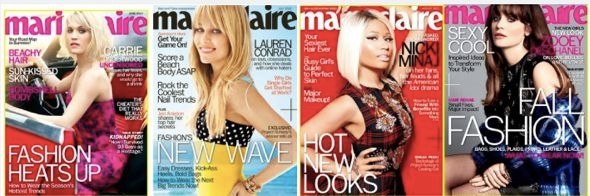
After the brand name, the second objective is to relay the new-ness
of the latest issue. Magazines want to be sure that readers know that
they don’t have this particular issue yet. There are a few ways to do
this, but a good method is to use different colors month to month. Even
if the covers look pretty much the same otherwise.
Marie Claire magazine covers, June, July, August, and September 2013.
Then the photograph. The photograph aims to connect with the reader
through eye contact and a recognizable celebrity face. But the
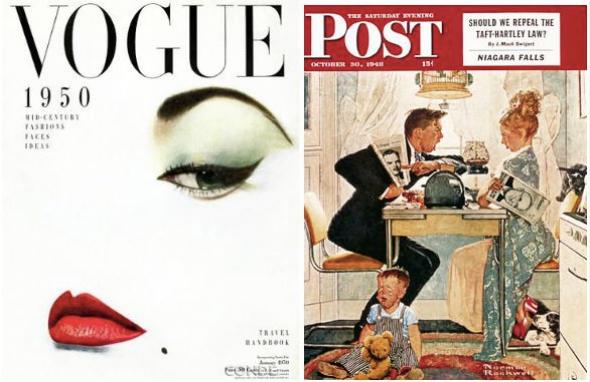
photograph wasn’t always part of the equation. Early magazine covers
were essentially illustrated.
Vogue, January 1950; The Saturday Evening Post, October 1948.
And these illustrated covers usually did not feature celebrities.
They were mostly scenes from fantasy or everyday life, or they featured
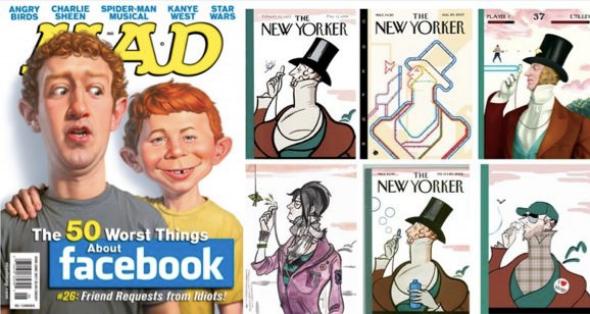
the publication’s illustrated mascot. Some of these characters persist
today, like the Playboy bunny, Mad's Alfred E. Neuman, and TheNew Yorker's monocled Eustace Tilley.
Mad magazine, June 2011; Variations of TheNew Yorker's Eustace Tilley.
Even U.K. Vogue had an illustrated mascot—Ms. Exeter, an elegant 50-something woman who had an advice column about being a classy, classy dame.
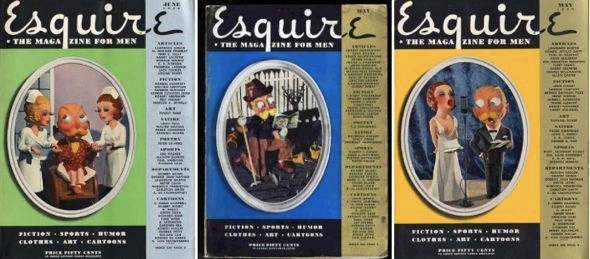
And Esquire had Esky, a mustachioed skirt-chaser.
Esquire, June 1948, May 1935, May 1934.
A lot of Esquire covers featured Esky. That is, until George Lois came along.
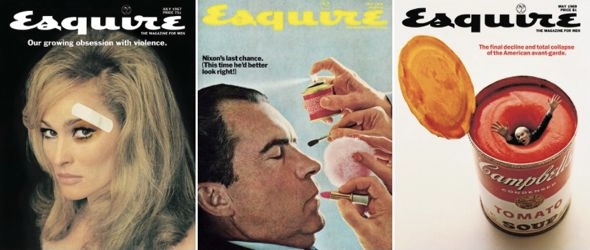
George Lois revolutionized the cover of Esquire, using big, bold, eye-catching photographs. You’ve probably seen some of these covers, or at least homages to them.
Esquire, July 1967, May 1968, May 1969.
The crazy thing was that Lois didn’t even work for Esquire. He was an ad man. He did commercial work.
In 1962, Harold Hayes, the newly hired head editor of Esquire, asked
Lois to do a cover for him. As Lois tells it, Hayes was desperate and
needed a cover in three days. Hayes gave Lois a description of 20
contents in the upcoming issue, including a spread of Floyd Patterson
and Sonny Liston, who were about to go head to head in the upcoming
heavyweight fight. Everyone was predicting that Patterson would win, and
the magazine was going to be released before the fight.
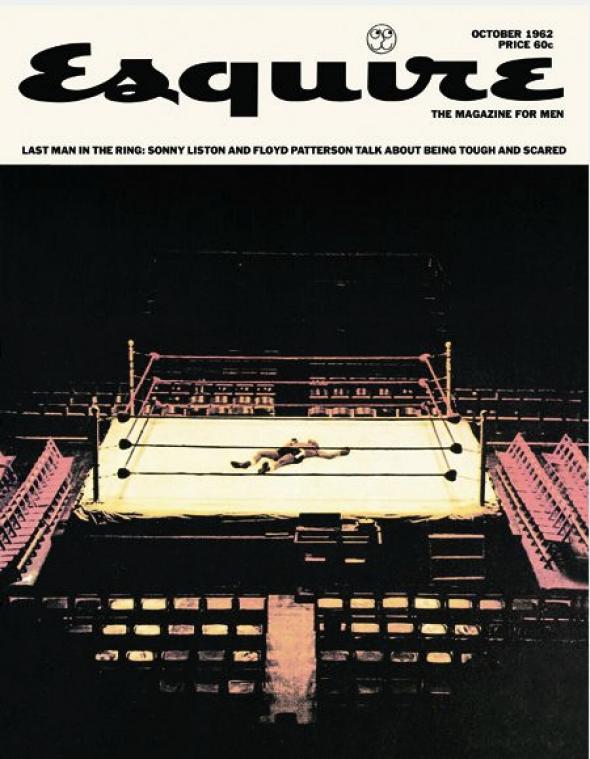
Three days later, Lois delivered a cover of a Floyd Patterson
doppelgänger laying flat on his back, dead in the ring. The message was
clear: Esquire was calling the fight for Liston.
Esquire, October 1962.
So there was a good chance that Esquire would be wrong, which would be completely embarrassing. But Harold Hayes let Lois go with it. And Lois actually got it right.
Lois went on to create 92 Esquire coversover the
next 19 years, most of them just as eye-catching and controversial as
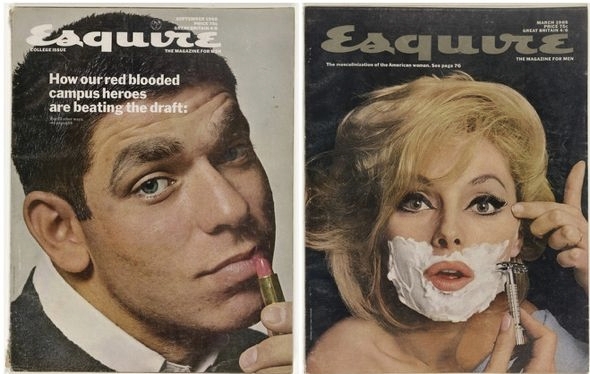
his first. Many were one big stark image, with little or no text. They
almost look like wall posters, and now many of them are in the permanent collection of the Museum of Modern Art in New York.
Esquire, September 1966, March 1965.
If you’ve seen any of Lois’ covers, or variations of his covers, it’s
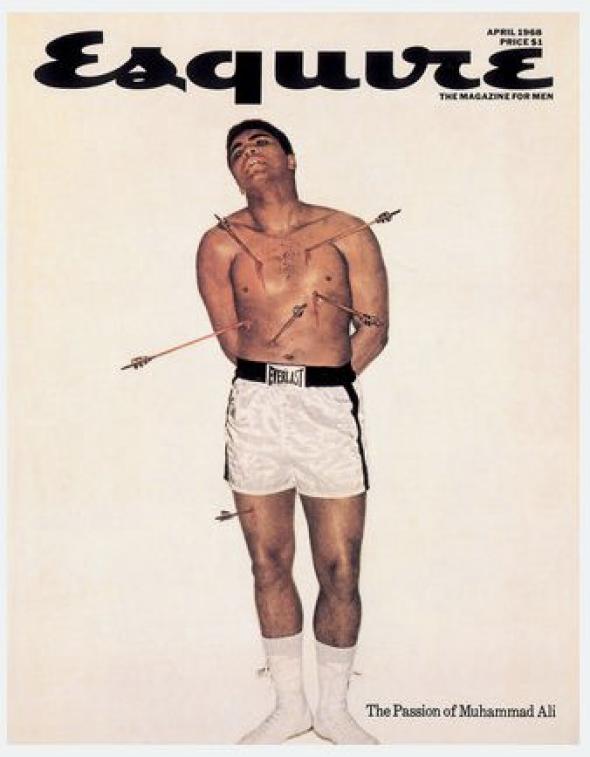
probably his photograph of Muhammad Ali, which is sometimes cited as
the greatest magazine cover of all time. The cover is almost completely
white, with Muhammad Ali, shirtless, pierced all over his body with
arrows. Like a martyr.
Esquire, April 1968.
Ali had refused military service, claiming conscientious objector
status through his conversion to Islam. Ali was sentenced to jail,
stripped of all his titles, and condemned as a draft dodger—some even
called him a traitor. The idea of this cover was to suggest that he was a
martyr to his religion, but George Lois chose a Christian martyr to
represent him—specifically, St. Sebastian.
Ali called up Nation of Islam leader Elijah Muhammad and explained
the painting on which this photo was based in excruciating detail,
before finally putting George Lois on the phone. After a lengthy
theological discussion, Elijah Muhammad gave George Lois his OK.
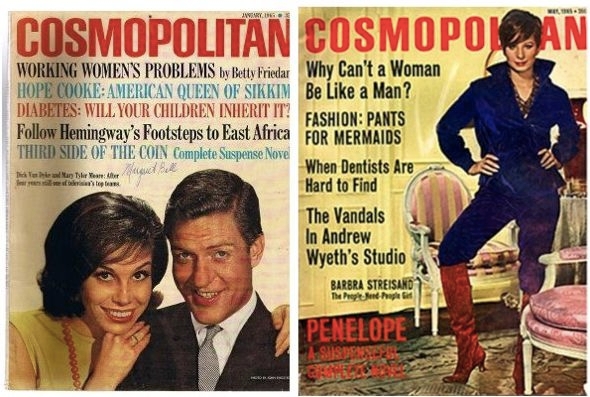
So Lois helped make photographs more or less standard on magazine covers. Then, in 1965, Cosmopolitan ushered in the era of the cover lines, aka words.
Cosmopolitan, January 1965, May 1965.
Cosmopolitan wasn’t the first to use text on the cover, but
it was the first to use it really provocatively, and it set the standard
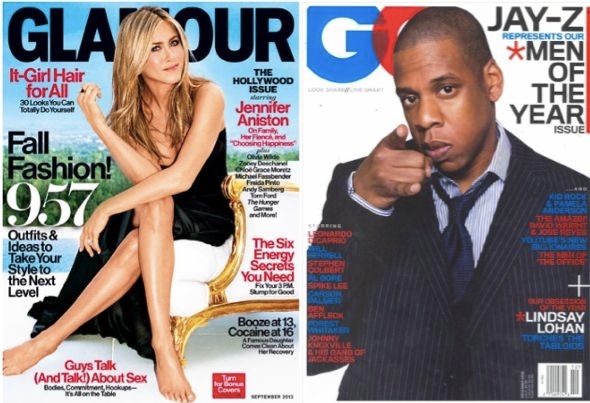
template for what a newsstand magazine looks like today. Covers started
to frame their photographs with words, creating a sort of “doughnut” of
text around the featured image.
Glamour, September 2013; GQ, December 2006.
Even though magazines are covered in words, there’s tremendous debate
among editors and art directors as to how to maximize the value of the
key pieces of real estate on a magazine front cover. These key pieces of
real estate vary depending on the kind of magazine.
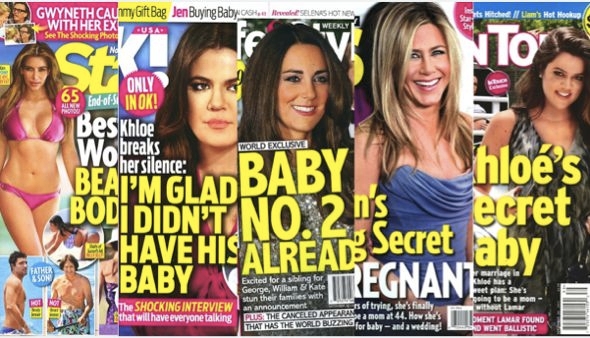
Celebrity weeklies always have their big coverline across the middle
of the magazine. And it’s almost always written in yellow, since it pops
on the newsstand. The whole weekly market relies on yellow.
Star; OK!; Life&Style; Us; In Touch.
For the more lifestyle-oriented magazines, the most captivating cover
lines go in what’s called the hotspot, located immediately underneath
the logo on the left. Unless it’s on the right. Magazines are racked
differently in different countries, and racking patterns often shape
page layout.
In the U.K., a lot of the magazines are shuffled with their left
edges overlaying each other, with only the left edge revealed. So in
England you get most of your headlines on the left side, or “the leading
left edge.”
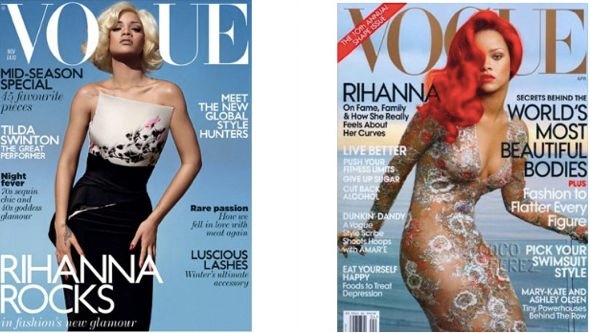
In the United States, magazines are racked in a waterfall
presentation, where you see the top third, so our publications stick
their best cover lines high and close to the logo on either side.
U.S. publications have many more coverlines than those in the U.K. Purely because of the way they’re stacked up for retail.
U.K. Vogue, November 2011; U.S. Vogue, April 2011.
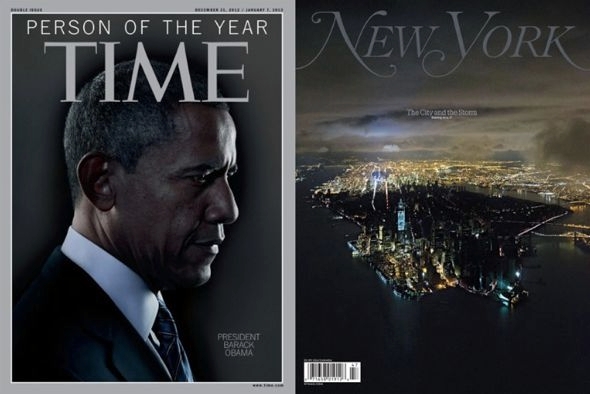
Magazines that don’t rely on newsstand sales look very different from magazines that do. Titles like the Atlantic, Time, and TheNew Yorker have the luxury of not needing to grab someone’s attention at the checkout line.
These are a little more Lois-esque, with big photographs and pictures and not as much text.
Time, Dec. 31, 2012-Jan. 7, 2013; New York, Nov. 4, 2012.
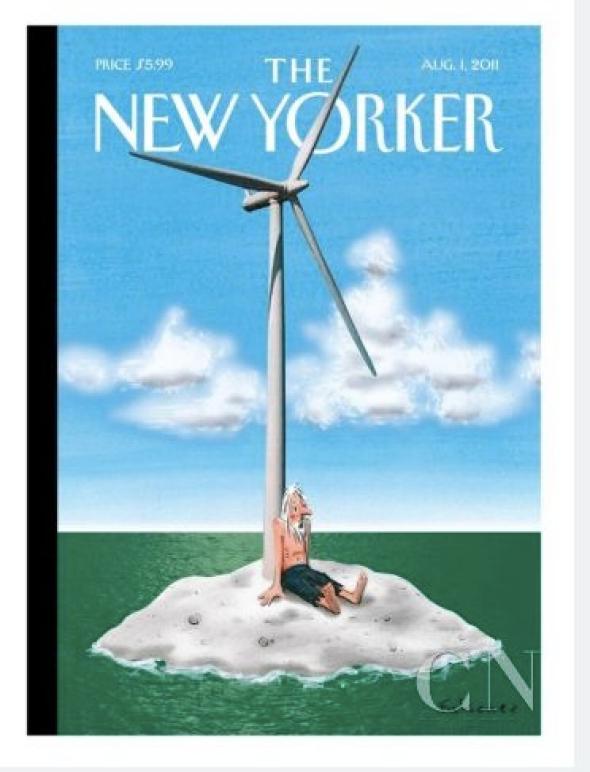
The New Yorker even reverts back to the pre-1960s illustration model for subscribers:
The New Yorker, Aug. 1, 2011.
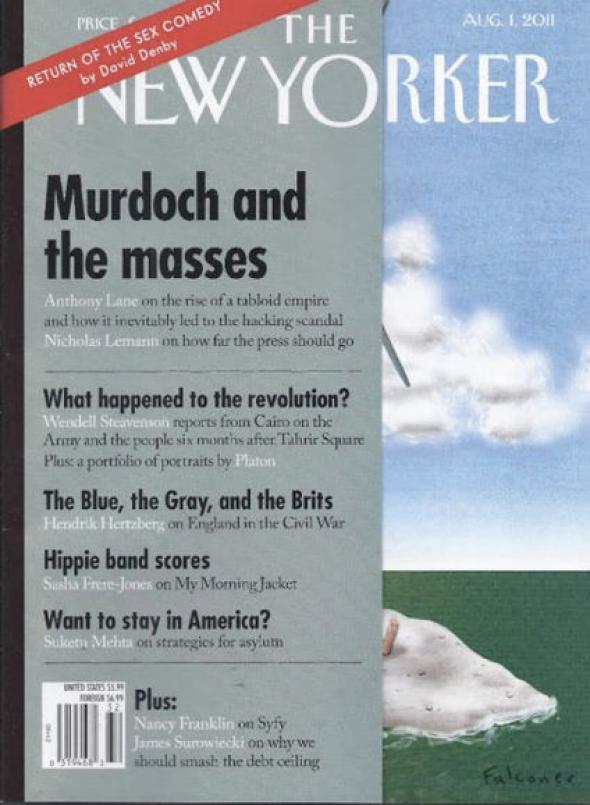
When you encounter TheNew Yorker on the newsstand, there’s a little flap on the leading left edge with a list of contents.
The New Yorker, Aug. 1, 2011.
Big pictures by themselves just don’t sell like they used to. It’s
about volume of content. Magazines are expensive on newsstands, and
readers want to be reassured that there’s plenty to read inside. Hence
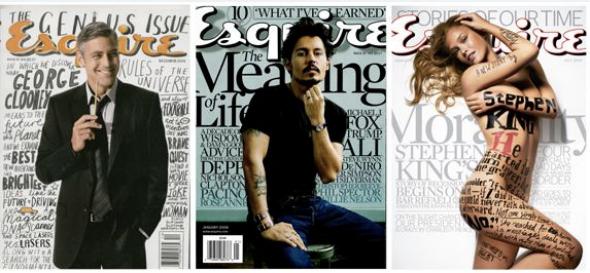
the illegible cornucopia of headlines on Esquire today.
Esquire, December 2006, January 2008, July 2009.
This is the work of David Curcurito, current design director at Esquire. Curcurito’s
style is so overloaded with words that it explodes the “doughnut.” The
text is not just about communicating what information is in the issue,
but showing you that there’s a lot of it.
The text and the image weave in and out of each other in such a way that the words almost act like an image. This is Esquire’s
way of standing out from all the other magazines on the rack. But it
doesn't stand out in the same way Lois’ covers did. Curcurito has messed
with the standard magazine formula, but he tends to stick to it.
Because this formula works. And it has been working for a long time.
But fear not, art directors everywhere, George Lois has a simple solution: mimic his covers.



No comments:
Post a Comment